
The concept of “employee engagement” was coined in 1990 by a Boston University professor named William Kahn, who spent time studying summer camp counselors and architecture firms and concluded that workers bring varying degrees of themselves, physically, cognitively, emotionally, to their roles. His conditions were thoughtful: meaningfulness, psychological safety, availability. His paper was about human dignity at work.
Gallup got hold of it six years later and ran thousands of questions through a statistical correlation engine until they had twelve that predicted business outcomes. Profitability. Retention. Customer scores. They called the result a measure of employee engagement. The questions that survived were the ones that correlated with the organization’s success, which is not the same as the employee’s. Neither distinction was made in the marketing. It rarely is.
Gallup named what it built a “people analytics tool.” The accurate description is closer to a revenue instrument that learned to speak the language of wellbeing.
By the mid-2000s, engagement had become an industry. HR consultancies multiplied. Surveys proliferated. Every vendor had a proprietary definition and a proprietary measure, which is how you know the concept was never settled. Google searches for “employee engagement” went from roughly 50,000 results in the early 2000s to 47 million within a decade. The concept itself was doing the thing it described: showing up, busy, generating output, not entirely sure what it was for.
What engagement solved for the corporation was a vocabulary problem. You cannot ask employees to donate labor they are not paid for. You can ask them to be engaged. The word absorbs the transaction. The employee who stays late, mentors a colleague, attends the non-mandatory Friday session, volunteers for the cross-functional task force: they are not working unpaid overtime. They are engaged. They are bringing their full selves. The concept turned a labor extraction problem into a psychological achievement, and the employee who declined was not protecting their time. They were failing a wellness metric.
This is not a reading between the lines. The lines actually say that. Kahn’s original paper defined disengagement as “the uncoupling of selves from work roles.” That framing, self not labor; uncoupling not refusal, has held. Every subsequent definition of quiet quitting inherits it. The worker who leaves at five is not compliant. They are withdrawn. Something is wrong with them, not with the deal.
Now watch what quiet quitting does to that vocabulary.
It names the behavior from the worker’s side. It says: there is a floor here, and standing on the floor is something that needs naming. The name is awkward, you are not quitting, you are present, working, technically doing what you were hired for, but the awkwardness is the point. The behavior needed a name because no existing language could hold it without loading it with pathology. “Disengaged” was already taken, by Gallup, and it already meant broken.
You have probably been told the term was coined on TikTok in March 2022 by a Nashville career coach named Bryan Creely. Maybe you were told it was economist Mark Bolger in 2009. The origin is contested, which is itself a signal. When a concept arrives before the vocabulary, people reach for words wherever they find them. The concept had been there for decades.
Since 1979, productivity in the U.S. economy grew 90 percent. Hourly compensation for the typical worker grew 33 percent. The Economic Policy Institute has tracked this gap for years. If pay had kept pace with productivity, the median worker would earn roughly sixteen dollars more per hour today. That number was, per EPI’s own framing, a “failure by design,” engineered through policy choices: weakened unions, tolerated unemployment, eroded minimum wage, corporate globalization. Union membership in the private sector peaked at 35 percent in the 1950s. Today it sits at 6 percent. The mechanism that once converted productivity gains into wage gains was systematically dismantled.
Which board meeting ran long because the numbers were wrong in that direction?
Quiet quitting, from this view, is a delayed price signal. Workers noticed, over decades, that extra effort did not price into the next contract. The psychological contract, do more than required and more will come back, stopped paying out. What you are calling a withdrawal of engagement is a workforce updating its priors.
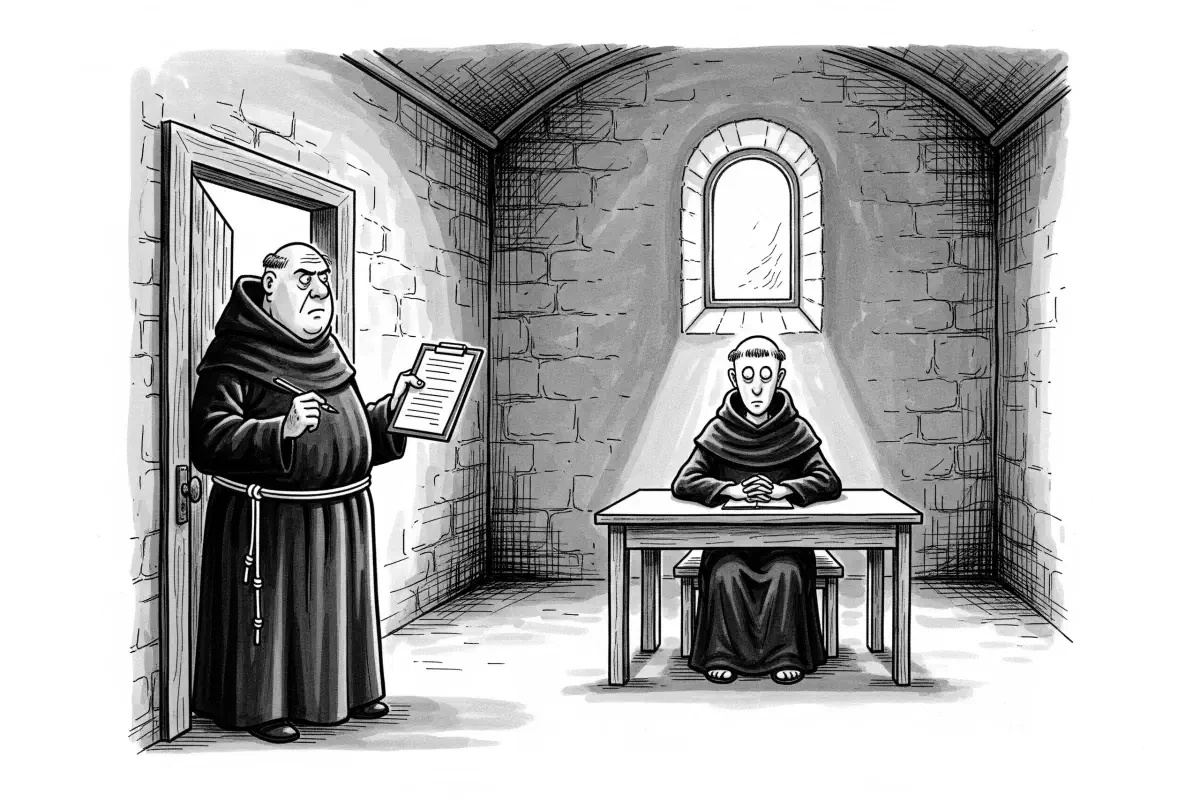
Religions solved this problem centuries before HR departments existed. A monastery needs monks to pray at three in the morning. Prayer is hard to surveil and harder to compel. The solution was not a performance review. It was a theology of intrinsic reward so complete that the monk who did not want to pray was not underpaid. He was spiritually deficient. The engaged employee who volunteers for the non-mandatory meeting is not working for free. They are living their values. The vocabulary of calling, of purpose, of bringing your whole self: it is old vocabulary. It pre-dates Kahn by millennia. It has always done the same work.
Now consider the 2025 Human Resource Management study that found perceived lack of control to be the primary precursor to quiet quitting. Not attitude. Not generation. Control perception drops when layoffs happen, when budgets are cut, when restructuring memos arrive with no warning and cost people their jobs by Friday. It drops when the message is: we will keep you as long as you are useful, and we will describe your removal as a business necessity. Workers who heard that message, repeatedly, across years, responded by not betting their time and health on reciprocity that was not coming.
Institutional responses to this have been to look at the worker. Managers are advised to examine their leadership. Engagement surveys are sent. Culture initiatives are funded. Korn Ferry, Deloitte and McKinsey write the reports. Gallup sells the measurement. The consulting firms sell the remediation. None of them propose making the implicit contract explicit, because making it explicit would require naming what is actually being asked, which is for workers to donate surplus labor for reasons that redound primarily to shareholders.
Workers now have a counter-vocabulary, however imperfect. They have a name for not praying at three in the morning. The institution named disengagement first and made it pathology. Workers named compliance and made it resistance. What is actually happening is that two parties are negotiating a contract that neither has written down, and one of them just stopped pretending the unwritten terms were generous.
Gallup’s own data contains the exit from this. Eighty-five percent of quiet quitters could tell researchers exactly what one change would fix it. Engagement and culture came first. Pay came second. Nine out of ten said they could be incentivized to work harder. Only ten percent appeared fully out. This is clearly a negotiation with no table. “Quiet quitting” will age out. A new term will arrive and another consulting cycle will begin triggering another set of surveys and the gap between productivity and pay will continue on its current line.
The monks who stopped praying at three in the morning were not spiritually deficient. They were tired, and the terms had not been honored. The monastery did not rewrite the contract. It wrote better sermons about vocation.