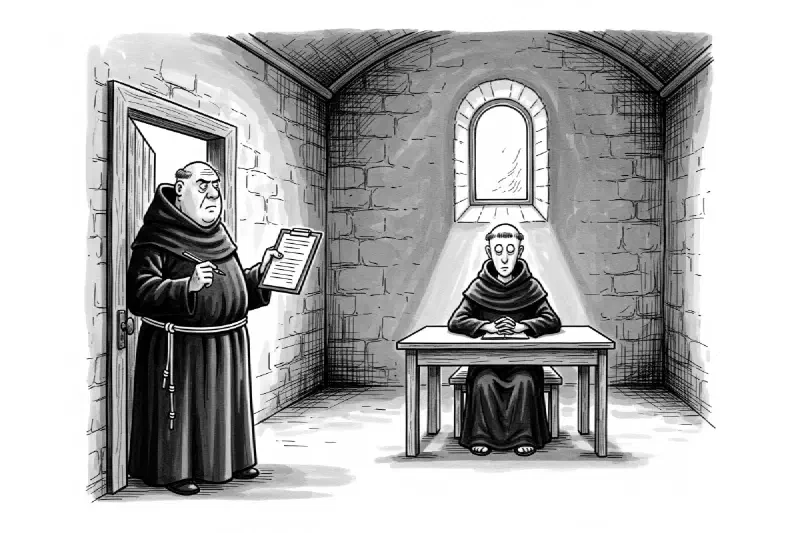

The polite term is “limited information sharing.” What it has always been called by the people on the receiving end is mushroom management. Keep them in the dark. Feed them bullshit.
Frederick Winslow Taylor published The Principles of Scientific Management in 1911 with a clear argument: management should think; workers should execute. Taylor built the entire model around that separation. Thinking was management’s work. Doing was everyone else’s. Workers given context, he believed, would form opinions about the work and slow it down. He ran the experiment in steel mills and called the results efficiency.
But even Taylor was late. Medieval guilds hoarded craft knowledge as a control mechanism: an apprentice who learned the whole craft became a journeyman who could leave. The Roman army operated on need-to-know at the legionary level. The centurion knew the next hill. The emperor knew the empire. That gap was the architecture of control, and nobody intended to close that gap.
The corporation did not invent information hierarchy. It inherited it and gave it a job description. The org chart became a map of permitted knowledge. Here is what you do. Here is the edge of what you are sanctioned to understand. The bureaucratic innovation was formalization: not just withholding information, but making the withholding structural, invisible, and compatible with the performance review cycle. I have never seen or heard of an organization that invites regular employees into a management review, a quarterly or a budget session. Not to contribute. As a silent witness. I’ve sat in enough of those rooms: most of what gets discussed is what Peter can do to boost sales and what Anna should publicly say about Gabriel moving to a competitor. Those rooms are the kitchen where the narrative is cooked. Chefs don’t invite witnesses to the prep.
The institution that examined this honestly was the US Army. After Vietnam and through the 1980s, after-action analysis kept surfacing the same finding: soldiers in the field made wrong decisions when plans broke down and they lacked the “why” behind their orders. The Army changed its doctrine. Mission Command, codified in Field Manual 6-0, explicitly rejected information hoarding in favor of sharing commander’s intent at every level. The reasoning was clear: when people don’t know the goal, they cannot adapt when the situation changes. The cost of that ignorance had been specific, attributable, and counted in names.
Corporate management has the same evidence. It has not made the same change.
Gallup’s 2023 State of the Global Workplace report estimated the cost of low employee engagement at approximately $8.8 trillion annually, around 9% of global GDP. Only 23% of employees worldwide report being engaged at work. Amy Edmondson’s research on psychological safety, conducted first in ICU nursing units at Harvard, found that teams where members felt informed and heard made fewer errors and flagged problems faster. The original finding was not about morale. It was about patient mortality. The mechanism has since been documented across industries: people who understand the goal can see when something is going wrong. People who only understand their task cannot.
The standard reading of mushroom management treats it as a mistake, a company that wants performance inadvertently destroying it through poor communication. The fix, on this reading, is better communication. But that reading fully rests on an assumption: that the company wants performance in the way the people inside it understand performance.
What if it doesn’t?
A compliant employee executes instructions when given them. They do not ask why, because why was never provided. They do not propose alternatives, because they lack the context to know alternatives exist. When something goes wrong, they are not implicated: they followed instructions. The person who gave the instructions is not implicated either: they provided the task. The accountability diffuses before it can settle on anyone.
Withholding information did not become professional instinct by accident. It was rewarded, not with a policy, but with the quiet observation of what happened to some who tried it differently.
There is a term for a liability structure that distributes responsibility so widely that specific failures cannot be traced to specific decisions. Lawyers call it a defense posture. Mushroom management does not produce incompetent employees. It produces employees who cannot testify against the system that employed them.
Soldiers died when information broke down in the field. An army ran the after-action reviews, found the mechanism, and changed the doctrine. Specific people had died because specific information had not traveled far enough down the chain.
Corporate ignorance kills differently, in Gallup aggregate figures, in turnover costs that never appear as a line item traceable to a policy choice, in a number that occupies a report and becomes no one’s accountability. Nobody dies from not knowing the Q3 strategy. Nobody can say: this person left because this manager hoarded context, that the cost was this amount, and that someone decided to pay it.
What is harder to answer is whether any of this is intentional. The corporation that withholds context rarely has a policy saying so. Nobody convened a meeting to design a liability structure from human ignorance. The incentives built it, reward by reward, until the intention became irrelevant. Which leaves one question. Somewhere inside what has been built, is there purpose? Not a mission statement. Purpose in the sense that a person goes home knowing what they contributed and why it mattered. Fifty thousand employees cannot all know the strategy. True, and beside the point. Nobody is asking everyone to carry the CEO’s memo. The ask is simpler: can a manager explain to her team why this specific task matters, within this specific chain, toward this specific end? That conversation happens at every level or it does not happen at all. Organizations that have never had it are not innocent by virtue of never deciding to cause harm. They are culpable for never stopping to ask whether they were. Work, at its least dishonest, is about purpose. Most have chosen not to look.