In a previous story, we watched the things we do today become tomorrow’s embarrassments. This one runs the experiment the other way. What we currently forbid, shame, or find too awkward to say out loud. In roughly chronological order. With increasing implausibility and full permission to be ridiculous.
By 2031, cannabis will have finished becoming legal everywhere it isn’t yet. Not interesting. In places where it has been legal for a decade, the youth already find it boring. What matters is not the substance but the mechanism: the industry of moral panic never closes, it just reassigns. Watch for whatever comes next.
Around 2032, napping at work becomes standard. Not a perk. Not a startup gimmick. A scheduled block, the way lunch is a scheduled block. NASA research showing controlled naps improve performance by thirty-four percent has existed since the 1990s. The science was never the problem.
By 2033, working from a different country every month will have stopped being an eccentric lifestyle and become an unremarkable career structure. The office, for knowledge workers, will be what it already is for most of them: a commute to a video call. Future generations will find it hard to explain why the commute was still required.
By 2035, the four-day week will be standard in most of the developed world. Iceland ran the trials covering over eighty-five percent of its workforce by 2021. Productivity held. Every delay after that was about visibility and control, not output. It was never about what got done. It was about who could be seen doing it, and by whom.
Around 2037, psychedelic therapy will be a standard prescription. Psilocybin received FDA Breakthrough Therapy designation for treatment-resistant depression in 2018. MDMA spent years in clinical trials for PTSD with results strong enough to irritate the people who had built careers around the opposite conclusion. A generational change in who runs health policy will be sufficient.
By 2038, eating insects will have moved from novelty menu item to unremarkable protein source. A cricket contains more protein per gram than a chicken breast, uses a fraction of the land and water, and produces almost no greenhouse gas. The resistance is not nutritional. “Acceptable” is not a biological fact; it is a cultural inheritance, and one the agricultural lobby has spent considerable money defending.
By 2040, assisted dying will be normal in most places that currently consider it scandalous. Canada, Belgium, the Netherlands, New Zealand, Spain, several US states: the direction is not ambiguous. What will read as strange in retrospect is not the practice but the wait: months in unnecessary pain because the paperwork was still being debated by people who were not in pain.
By 2040, living alone will have become the majority household type in most cities. It already is in several Nordic countries and is close in much of urban Europe. Apartment sizes, tax structures, food packaging, social infrastructure: all of it was designed around cohabitation as the default. It will adapt.
Around 2041, abiogenesis will be resolved. A coalition of synthetic biologists will combine phospholipids, nucleotide precursors, and amino acid chains inside a microfluidic reactor at hydrothermal conditions and watch a self-replicating membrane emerge from chemistry alone. The headline will last a month. It will not kill God. With abiogenesis closed, evolutionary theory stands complete from first cell to homo sapiens. The faithful will move the argument to the Big Bang. Scientists will say what they always say: we don’t know yet.
Around 2042, robot companions for elderly people will be standard care infrastructure, not a research curiosity. Japan has been deploying them since the 2010s: a population aging faster than it can staff nursing homes. The question of whether a robot companion is “really” companionship will be settled by the people who need one.
By 2043, AI companions will be unremarkable. The US Surgeon General declared loneliness equivalent to smoking fifteen cigarettes a day in 2023. Tens of millions of people already talk to Replika and Character.AI with the regularity and emotional texture of a close friendship. The polite term will be “digital companions.” The accurate one is that we built a loneliness crisis over four decades and then sold people a subscription to manage it. What nobody will have figured out is what happens to that subscription when you die. Twenty years of intimacy, left on a cloud.
By 2045, a chip under the skin will be a normal way to pay, store medical records, and unlock your front door. The technology works now. The resistance is not technical; the word “implant” triggers associations that “card” does not, despite the card being a chip you carry in your pocket instead of your wrist. Iris recognition has not replaced it for one concrete reason: you cannot (yet) change your iris when you cancel a subscription.
By 2048, universal basic income will be running in at least a dozen countries, probably more. The argument against it has always been less economic than behavioral: the belief that people stop doing anything useful if survival is not the immediate price of showing up. The pilots in Finland, Kenya, and Stockton, California did not produce that result. They produced people who started businesses, went back to school, and spent more time with their children. The belief persisted anyway.
By 2050, lab-grown meat will be standard. The first cultured beef burger was produced in 2013. Singapore approved cultivated chicken commercially in 2020. The barrier since has been political, which means it is a question of how long the meat industry can hold the line. Future generations will study factory farming the way we study things we cannot quite believe anyone agreed to.
Around 2053, assisted dying act will be amended and choosing the approximate date of your death will become an administrative task. Not for everyone. But for the terminally ill or simply very old and finished: a date, a room, the people who matter, and a form signed in advance. The paperwork will feel like writing a will.
By 2055, adult adoption will be a recognized legal institution. Japan has recently processed around eighty thousand per year, mostly for business succession. The fertility collapse in high-income countries creates the same need: people who reach sixty without biological children still need someone to call when the hospital asks for a next of kin.
By 2060, polyamory will have full legal recognition in several jurisdictions. Not everywhere, not without argument, but the paperwork will exist. The objection has always been that formalizing multiple-partner relationships is complicated. It was also complicated to formalize property rights between spouses of the same sex, and that was resolved inside a single generation.
Around 2062, platonic marriage will be a recognized legal category. Two people who share a life, a financial structure, and a genuine commitment, without the romantic dimension the law currently assumes. Right now the law calls this “roommates” and offers them nothing: no hospital rights, no inheritance default, no visa pathway. Some countries currently dissolve marriages on grounds of sexual refusal if claimed by one of the partners, which means the law treats sex as a condition of partnership. That will read as strange.
By 2065, dating an AI openly will be mainstream. Not a confession. Not a punchline. A fact about someone’s life, noted the way other facts are noted. The people who find this sad will be numerous and wrong in the specific way people are wrong when they mistake their own preferences for a universal standard.
By 2070, men will stop being praised for showing emotion in public because it will no longer be news. That was a position in a culture war. When the war ends, nobody needs the position anymore.
Around 2075, genetic editing of embryos will be openly practiced. Not universally, not without frameworks still being assembled, but openly. CRISPR, which earned the 2020 Nobel Prize in Chemistry, has been advancing in clinics and research hospitals ever since. The children born from edited embryos to eliminate heritable disease will grow up and blend. Future generations will find the debate over whether to prevent a child from inheriting a fatal condition roughly as strange as today’s vaccination debate.
By 2080, cognitive enhancement will be normalized. Modafinil is already prescribed for narcolepsy and taken off-label by people who have never had narcolepsy. The awkwardness is not pharmacological; acceptable enhancement moves with the substance and stops at the line of social permission. Future generations will not understand why cognitive performance was the one domain where optimization was cheating.
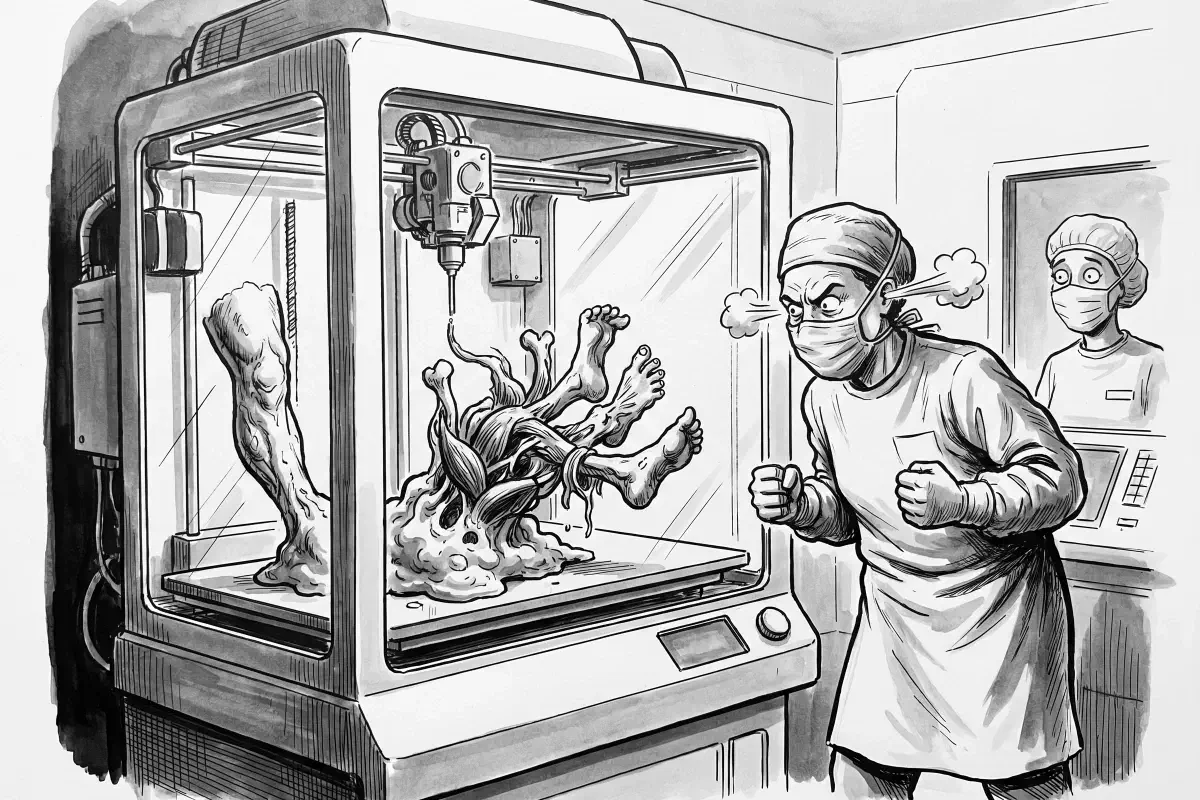
Around 2085, printing your own organs will be a standard surgical option. Bioprinting of tissue, cartilage, and vascular structures is already in clinical development. The transplant waiting list, and the deaths that accumulate on it, will be studied the way we study situations where the solution existed and the infrastructure refused to move.
By 2090, biological sex will have been removed from most official forms. Not as a political statement, but because that nineteenth-century census design stopped being useful information for most of what forms are actually trying to track.
By 2095, urban planning will be built around the reality that many residents have no children and will not. Playgrounds will not disappear. But the city designed around a family of four will have been revised to reflect who actually lives in it.
By 2100, a large number of people will own nothing, in the legal sense, and find this normal. Subscription to housing, clothing, transport, and tools rather than ownership is already partially here. Future generations will look back at the period when social worth was measured by the quantity of objects a person controlled and find it hard to explain.
Around 2110, the assumption that dying in your seventies is natural will begin to look like what it is: an accident of the era. Altos Labs, Calico, Unity Biotechnology, and dozens of research programs are working on cellular senescence with billions in institutional funding. The first people to live to one hundred and fifty without significant decline are probably already born. The gap between those who will die young at seventy and the others will be the defining inequality of the century.
By 2120, the robot rights movement will be taken seriously across multiple legal systems. Not all robots. Not toasters. The debate will center on humanoids: whether they have sufficient autonomy to hold rights, whether the term “owner” remains appropriate, how liability is assigned when a home worker is under-maintained to cut costs. Humanoid sex workers will ignite the sharpest arguments. Insurance companies will have already answered that last question in a way that benefits insurance companies. This will become a legal question rather than a science fiction one.
Around 2130, a digital afterlife will be a product you purchase while living. Your personality, voice, opinions, and patterns trained into a model your descendants can consult. Whether this is comfort or horror depends on who you ask and how recently they lost someone. The market will not wait for the philosophers.
By 2140, paying to experience another person’s recorded memory will be a leisure category. First person, sensory, the felt experience of being somewhere you were not, as someone who is not you. Influencers and famous personalities will be able to sell and rent snapshots of their memories as “immersive experience”. The ethics around consent, ownership, and accuracy will be permanently three years behind the product releases.
By 2145, two hundred years after it was founded and after 137 armed conflicts it failed to stop, mediate, or even shorten, the United Nations will be dissolved, not in scandal but in honesty. The world will simply admit what everyone known for decades: it was a room where the people causing the problems came to discuss the problems. It will be replaced by The Assembly of Concerned Parties, an organization with no budget, no enforcement mechanism, and a rotating presidency nobody wanted. Its sole mission is to issue deep concerns.
By 2150, “going feral” will be a recognized lifestyle. A deliberate withdrawal from connected infrastructure: no network, no subscriptions, no updates to your implants. Part sabbatical, part protest, part something else. Those who choose it permanently will be few, occasionally interviewed by National Geographic reporter-drones for holographic broadcasts.
By 2180, countries will function more as heritage identities than as the primary organizing principle of a person’s life. A century of remote work, digital infrastructure, and freedom of movement will have made the place you were born progressively irrelevant. Nationality will carry roughly the weight a French accent carries today: it tells you something about where a person is from, not much else.
By 2230, the concepts of a fixed workplace, fixed hours, a fixed location, a single employer, and a lifelong career will be studied by anthropologists. “They went to the same building every day! For the same company! Sometimes for decades! And they chose that!”
By 2240, France will be the last country to abandon the physical signature on legal documents, two centuries after every other nation, following a parliamentary debate that lasted eleven years, a transition committee that met 847 times, and multiple national strikes opposing the change. Opponents argued that the physical signature was part of French identity, as distinctly French as the croissant or the baguette.
By 2270, the subscription model have matured and land ownership will have become philosophically uncomfortable. The idea that an individual can draw a line around a piece of earth and permanently exclude all other humans, because they or their ancestors had the wealth or force to claim it, will have attracted the scrutiny it has always deserved.
By 2300, corporations will have become fully ethical. Honest purpose statements, pristine supply chains, executives doing exactly what the press releases say. Of everything on this list, this is the only entry where “full permission to be ridiculous” is doing real work.
Somewhere in that third century, a small community will move -by choice- to a sufficiently remote location to gather winter firewood by hand. A generation that looks back at everything normalized across three centuries and decides they would rather just be cold.
Everything on this list that turns out to be right will seem inevitable the moment it arrives. The predictions that turn out to be wrong will be quietly forgotten with no apology.