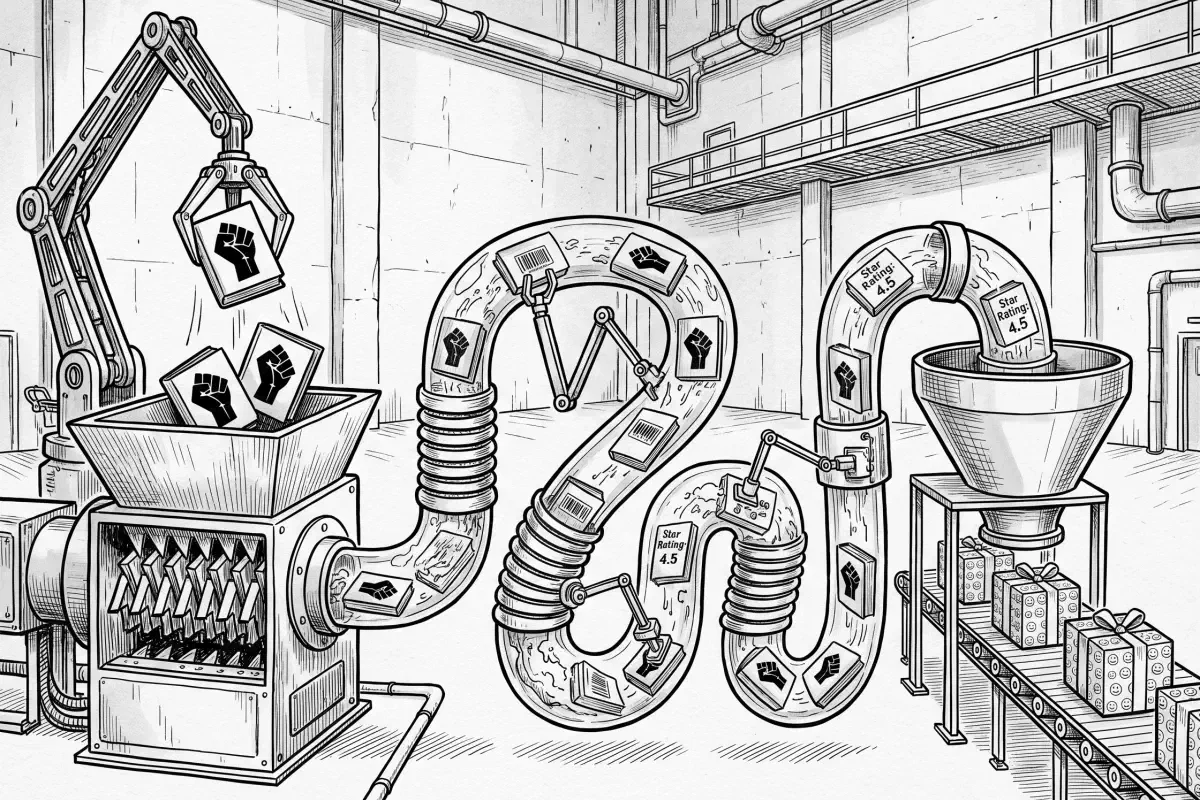
David Graeber spent decades arguing that most of modern work is designed to produce nothing of value while ensuring the people doing it feel guilty for noticing. He organized. He wrote. He helped build Occupy Wall Street. He died in 2020. His books are now on Audible. His face appears on merchandise. His arguments circulate as quote cards on a platform subsequently purchased by the exact billionaire archetype he spent his life dismantling.
That is what the system has learned to wait for. The polite term for what happens to a dangerous idea is dissemination. The accurate one is digestion.
Censorship makes martyrs. Banned books circulate with urgency; they carry the weight of forbidden things. The smarter play is absorption. Give the idea a genre label, a spine, a product page, a rating on Goodreads. Let it move through the supply chain. The idea survives. It just stops being a threat and starts being a purchase.
The Dawn of Everything is six hundred pages of evidence that hierarchy was a choice, not a destiny. That across history, people built power structures and then deliberately dismantled them. That the world we have was not inevitable. It is a mainstream bestseller now, stocked alongside the leadership memoirs.
The argument is intact. The implications are mostly not pursued because the recognition the book produces is real. When something names the structure you have been living inside without knowing it, that matters. You remember reading it. What gets lost is what you did the week after.
There is a version of this that says: put down the books and go make a difference. Organize. Help someone. Reading isn’t going to change anything. That position contains something true. A community that treats reading as the destination is not a movement.
But the logic is wrong. The women who organized the garment workers in New York in 1909 had read things. Emma Goldman read, then organized, then wrote, because she understood the sequence ran in every direction. The mutual aid networks that appeared during the pandemic, in cities where the state had made clear it was not coming, those people had shared frameworks. Frameworks do not appear from nowhere.
The failure is reading and calling it enough.
Absorption is not a temporary condition. It is not a bug with a fix pending. The infrastructure is permanent. Amazon will stock the next Graeber. The algorithm will surface the next quote card. The system built that pipeline because it helps convert dangerous ideas into consumer behavior and waits for the cycle to reset. The design relies on a simple bet: recognition produces satisfaction, and satisfaction produces inaction.
Refusing the pipeline is foolish; the only move left is the paradox of using the machine to dismantle it. The ideas will still travel through Amazon, funding the very systems they indict, but they must be treated as a radical entry point, not a comforting destination. Graeber reached people through Twitter. Organizers have always found each other through whatever channel existed.
The infrastructure does not care about what it carries and the platform is not afraid of what you have been reading. What it cannot control is what happens at the other end. The people who triggered real change did not refuse to touch the machine. They used it. They used the networks. They took the flash of recognition that books ignited in strangers and weaponized it into wildcat strikes, tenant unions, and mutual aid.