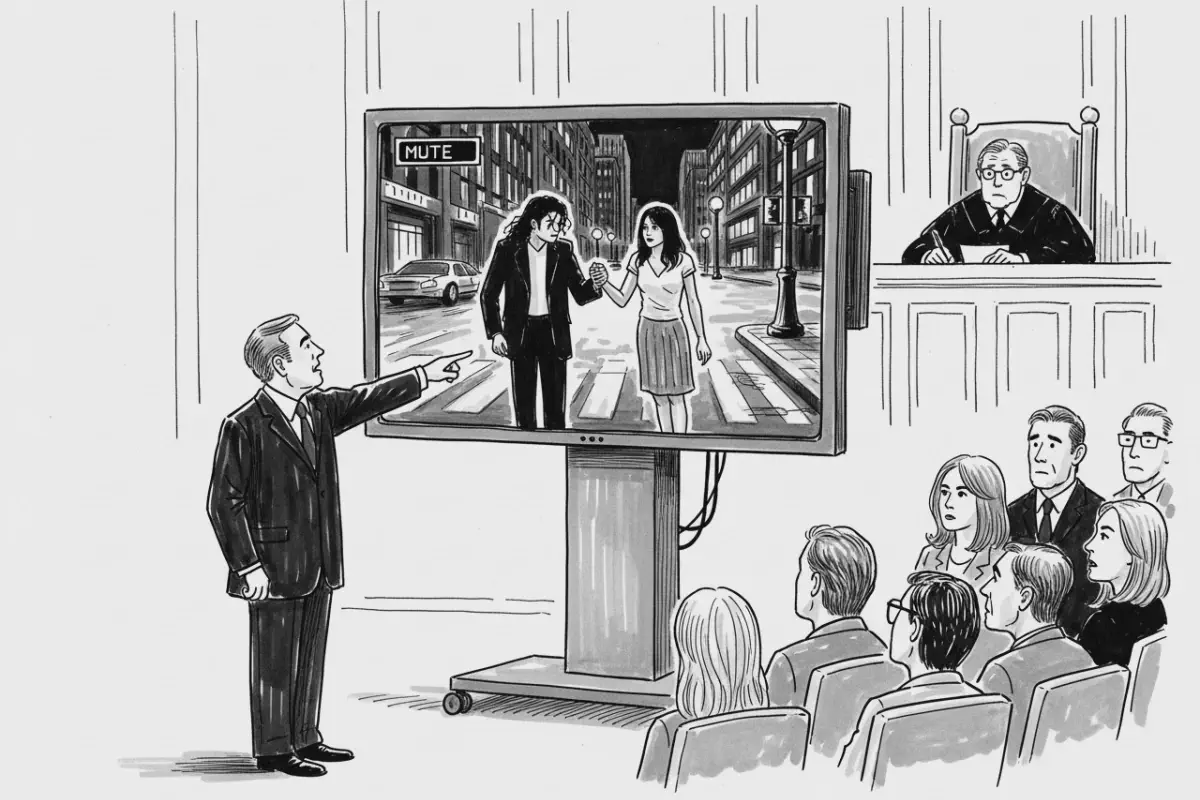
- The Prosecutor: Your Honour, this man spotted the victim on a city street at night. He wanted her attention. She did not give it. He followed her. His friends joined. She walked faster. They kept pace. He moved ahead and blocked her path. She stepped back. He stepped forward. This repeated.
- The Lawyer: Your Honour, she smiled.
- The Prosecutor: Your Honour, she was afraid not to.
A scene from Law & Order: Special Victims Unit, maybe. Or perhaps not.
Now mute your television. Find the music video for Michael Jackson’s The Way You Make Me Feel. Press play.
That is the same scene you will watch.
I love the music, but when I watched the clip recently, it triggered a strange thought.
In 1804, Aaron Burr was the sitting Vice President of the United States. That summer he shot Alexander Hamilton in a duel. The duel was legal. A gentleman who refused a challenge was the scandal, not the man who fired. By the standards of that moment, Burr’s conduct was defensible.
For most of recorded history, physicians treated illness by draining blood from the body. Two thousand years of medical consensus. The standard of the most educated people alive.
In the 1950s, American doctors appeared in advertisements recommending specific cigarette brands by name. Citing throat comfort. The Marlboro Man was an aspiration.
In 1949, the Nobel Prize in Physiology or Medicine went to the man who developed the lobotomy. Thousands of operations. Full institutional support.
In the UK, homosexuality was a criminal offence until 1967. Marriage equality is now law in many countries. One lifetime. A full reversal. The people who enforced the earlier standard were not monsters by the standards of their time. They were the law.
Statues go up. Statues come down. What changes is what the living decide to do with the stone.
Each one of these was the consensus of educated, credentialed people at the center of their civilization and never fringe positions held by ignorant people. The standard felt permanent because standards always do.
We tend to think of our current moral certainties the way Newton thought of gravity. Reliable. Universal. Proven. Newton was not a fool. His laws predicted the movement of planets. They built the industrial age. They still work well enough to land a spacecraft on the moon. But they were also incomplete, and the incompleteness only became visible when someone looked harder. Einstein looked harder. Space bends. Time is not absolute. The laws that had organized human understanding of the physical world for two centuries turned out to be an approximation of something stranger and harder to hold. Then quantum mechanics arrived, and Einstein’s picture turned out to be incomplete too. He spent the last decades of his life resisting it. One of the sharpest minds in history, unable to update past the framework that had made him great.
This is physics. The hardest, most proven, most precise knowledge we produce. It keeps getting revised. So if the ground shifts under physics, what do we imagine is holding up our ideas about right and wrong?
Democracy feels permanent from inside it. So did the divine right of kings. The Roman Republic lasted five centuries before it became an empire, and the Romans living through the transition had no clean way to understand what was happening to them. The Church organized the moral life of an entire civilization for over a millennium. Before it, other systems did. After it, others will.
The idea here is not really about democracy or religion, it’s about the lifespan of certainty. Every system of belief, including the ones built on the best evidence available, carries an expiration date that is missing on its selling label.
Which brings us back to the artist and the video clip.
Perhaps in fifty years Michael Jackson will be studied the way we study Mozart. A complicated biography sitting alongside work considered essential. His music taught to children, his story told to adults, the tension between the two left intact.
Or perhaps his name will be banned entirely. His videos pulled from platforms. His image handled the way we handle certain other figures from the twentieth century, present in the history books and nowhere else. A casualty of a future standard we cannot yet see from here.
Or perhaps something nobody has thought of yet. The same applies to the clip. What reads as sexual harassment in one era reads as romance in another. The acts on screen are the same but the grammar of time used to read them is different.
If that still feels too distant to be uncomfortable, try closer to home.
Think about the things we do today without a second thought. The rituals, the habits, the perfectly normal behavior of perfectly normal people in the year we are currently living in.
At children’s birthday parties, someone leans over a cake and blows. Spraying saliva over food that everyone at the table will then eat. It has been done this way for a century. A future generation, we cannot know which one, may find it as acceptable as spitting on a shared plate.
Alcohol is legal in most of the world. Sold in airports. Served at weddings. Handed to grieving people at funerals as a form of comfort. A substance that impairs judgment, fuels violence, and destroys organs, sitting in a glass next to the bread basket at a family dinner, completely unremarkable. Future generations may look back at this era the way we look back at the Victorian practice of prescribing laudanum to restless children. With genuine disbelief that nobody thought to stop it.
Parents post thousands of photographs of their children online. Building a digital identity for a person who cannot consent, before that person can speak, for public consumption, forever. Courts in several countries are beginning to hear cases about it. The children who grow up to read their own archived childhoods have not yet finished growing up. We will hear from them.
Maybe also the golf courses, those thousands of acres of chemically treated, heavily irrigated grass, kept immaculate at enormous environmental cost, so that a small number of people can spend an afternoon hitting a ball with a stick. In a world running short of water, surrounded by cities. Future generations may study them the way we study the hanging gardens of civilizations that no longer exist. Impressed by the ambition. Baffled by the priorities.
None of this is written to make anyone feel guilty for blowing out a candle or ordering a glass of wine. The point is simpler, every item on that list is right now, completely normal. Defended by reasonable people. Supported by law, by tradition, by social consensus. Exactly the way every item on the earlier list once was.
The only position that survives contact with history is a modest one. Hold your ideas as ideas of your era. Use them. Argue for them. Build with them. But stop treating your conclusions as the end of the conversation. Every truth comes with an expiration date it doesn’t advertise. Just do not confuse your ideas with the final word. Nobody gets to write the final word. Every generation that believed it did left the sentence unfinished.
The clip is still beautiful. Cheers.